.svg)
%201.svg)

%201.svg)

.svg)
%20(1).jpg)
A scientist calibrates a sensitive spectrometer. The readings drift. Not by much, but enough to matter. The culprit is not the equipment, not the HVAC system, not even the building's structure. It is the finish on the exposed timber beams overhead, still releasing compounds weeks after application.
This scenario keeps architects and specifiers up at night when they consider mass timber for laboratory environments. And it should. The coating you specify for a lab-ready mass timber building will determine whether that space can actually function as a laboratory. Not the wood. Not the structure. The coating.
I have spent years working on mass timber projects where air quality requirements go far beyond typical commercial standards. What I have learned is that the industry conversation around "low-VOC" coatings misses a critical nuance that laboratory specifiers cannot afford to overlook.
.jpg)
The Rise of Lab-Ready Mass Timber
Something interesting is happening in life sciences construction. Developers and design teams are choosing mass timber for buildings that will house sensitive scientific research. Projects like Northlake Commons in Seattle, the Adimab Biotech Building in New Hampshire, and Oregon State University's Huang Collaborative Innovation Complex demonstrate that mass timber can meet the rigorous demands of laboratory environments.
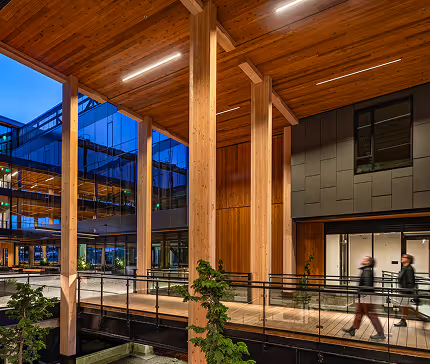
Northlake Commons is a project I know well. At 275,000 square feet of mixed-use space on Seattle's Lake Union, it achieved LEED Platinum certification while maintaining lab-ready capabilities throughout portions of the building. The structural system uses Douglas Fir glulam beams and CLT panels with exposed timber throughout.
The question that came up repeatedly during specification was straightforward: can we have beautiful exposed wood in a space where scientists will conduct sensitive work? The answer, it turns out, depends almost entirely on what goes on top of that wood.
What "Lab-Ready" Actually Demands
A useful way to think about lab-ready buildings is that they are commercial structures pre-configured to support scientific work. This means more than heavy-duty HVAC and vibration-isolated floors. It means the materials themselves cannot interfere with scientific processes.
Laboratory environments require enhanced mechanical systems including large fan and exhaust plenums, fume hood hookups, and backup power. They need structural performance that supports heavy equipment while restricting vibration. And they need finishes that meet both life-science standards and wood-building requirements.
The indoor air quality component is where coatings become critical. Sensitive instruments detect compounds at parts-per-billion levels. Research involving cell cultures, spectroscopy, or chromatography can be compromised by airborne contaminants that would go unnoticed in a typical office environment.
This creates a tension. Mass timber offers genuine benefits for laboratory occupants, including biophilic design elements that reduce stress and improve focus. But those benefits disappear if the space cannot function as a laboratory because the finishes are still off-gassing.
The IVOC Problem You Did Not Know You Had
Here is where the conversation about coatings typically goes wrong.
Most specifiers focus on VOC content. They look for products with low grams-per-liter ratings. They check for CARB and SCAQMD compliance. These are reasonable steps. But they miss a category of emissions that matters significantly in laboratory settings.
Intermediate-volatility organic compounds (IVOCs) are semi-volatile solvents and additives that standard VOC tests do not fully capture. They include glycol ethers, heavier hydrocarbons, and other compounds that off-gas slowly over weeks or months rather than evaporating quickly during application.
In typical commercial buildings, IVOCs may contribute to mild odors or slightly reduced air quality during the first few months after construction. In laboratory buildings, they can interfere with sensitive equipment, contaminate research samples, and compromise the very purpose of the space.
The distinction matters because a coating can be labeled "low-VOC" while still producing significant IVOC emissions. The regulatory frameworks that govern VOC content were not designed with laboratory air quality in mind. They address acute exposure during application, not the slow release of compounds over time.
How Testing Standards Are Evolving
The good news is that leading certification programs are beginning to address this gap.
GreenSeal's updated GS-11 standard now requires emissions testing using the California CDPH method on cured paint. This catches off-gassing from "exempt" solvents that simple VOC content testing does not reveal. For laboratory specifiers, this represents a meaningful advancement in how coatings are evaluated.
WELL v2 takes a broader approach through its Material concepts. Feature X10 addresses Volatile Compound Reduction with specific attention to phthalates, flame-retardants, and other semi-volatile compounds. Feature X11 encourages selecting finishes that off-gas slowly or periodically replacing materials that do not.
For practical specification purposes, look for coatings with:
- GreenGuard Gold certification (emission limits specifically designed for sensitive environments like schools and healthcare facilities)
- SCS Indoor Advantage Gold certification (chamber-tested emissions data)
- Ultra-low VOC content below 50 g/L (lower is better, with many high-performance options now at or near zero)
- No added formaldehyde in catalysts or hardeners
The certifications matter because they require actual emissions testing rather than calculated VOC content. A product can have zero VOC on the label and still emit compounds that affect indoor air quality.
Writing Specifications That Actually Work
In practice, laboratory coating specifications need to address several layers of the finish system. Each layer serves a purpose, and each creates potential for emissions.
The first layer is fire protection, if required. In corridors and exit paths, fire-retardant treatments must achieve the necessary flame-spread rating under ASTM E84. Some mass timber coating systems include intumescent primers that achieve Class A ratings (FSI ≤25, SDI=0) without requiring reapplication. For Northlake Commons, fire ratings were not required throughout, but the structural fire resistance of mass timber itself provided peace of mind.
The second layer is moisture protection. A penetrating sealer applied in controlled factory conditions protects the wood from moisture ingress, particularly at end-grain surfaces. The WoodWorks guide on architectural finishes emphasizes this step as essential for long-term performance.
The third layer provides UV resistance. Laboratory spaces often have significant daylight exposure. A waterborne finish with UV absorbers protects the wood from photodegradation while achieving the desired aesthetic. At Northlake Commons, we worked with the design team to develop "Latona White," a custom formulation slightly brighter than our standard PDX White, to achieve the bright, natural wood aesthetic they wanted.
The fourth layer adds durability. In laboratory contexts, the topcoat needs to resist cleaning chemicals and occasional spills. Modern catalyzed waterborne urethanes can meet SEFA-8 laboratory cabinet standards while remaining low-VOC and non-flammable.
The specification language should be explicit about emissions requirements. Rather than simply calling for "low-VOC" products, specify third-party certification to GreenGuard Gold or equivalent, require CDPH emissions testing results, and establish a minimum curing period before sensitive equipment operation.
.jpg)
Lessons from Northlake Commons
Working on Northlake Commons taught me several things about laboratory-compatible mass timber finishes.
The durability question is real. Seattle's Pacific Northwest climate, combined with the building's location on Lake Union, created significant moisture concerns during construction. Beams sat exposed to weather before the building envelope was complete. The coating system needed to protect the wood through harsh construction conditions while still meeting laboratory air quality requirements once the space was occupied.
Customization matters. The design team wanted exposed wood that looked relatively untreated, highlighting natural beauty with a matte finish. This meant working together to develop a formulation that achieved visual goals while maintaining performance. The result was a bright, light aesthetic that has held up well several years after completion.
Documentation enables certification. Northlake Commons achieved LEED Platinum status. This required demonstrating that all finishes met cumulative emissions thresholds. Having third-party test results and low-emitting labels simplified the compliance process significantly.
Problem-solving is part of the process. Some beams were wrapped before fully cured and got wet during transport, causing slight pigment migration. Rather than replace the beams, our team traveled to Seattle and consulted with the builders on hand touch-up techniques. A little sanding and blending resolved the issue without compromising either aesthetics or performance.
The outcome validated the approach. The products are considered safe enough for a building with exposed wood to be used for lab-ready scientific spaces. There is no IVOC off-gassing that would potentially disrupt scientific processes.
Practical Guidance for Your Next Project
If you are specifying coatings for a lab-ready mass timber building, consider the following:
Start the conversation early. Coating selection affects structural fire protection, construction sequencing, and commissioning timelines. Bring your coatings consultant into the project during design development rather than during construction documents.
Coordinate with HVAC design. Plan for enhanced ventilation during and immediately after coating application. Even the cleanest formulations benefit from fresh air exchange during curing. Many specifiers recommend several days of ventilation before operating sensitive laboratory equipment.
Test the specific products on your species. Douglas Fir behaves differently than Southern Yellow Pine or Spruce. The penetrating sealer that performs well on one species may need adjustment for another. Sample boards finished with your exact product system eliminate surprises.
Document everything. Request technical data sheets, Safety Data Sheets, and emissions test results for every product in the system. Keep records organized for LEED, WELL, or other certification submittals.
Consider maintenance over time. Laboratory spaces see heavy use. Even high-performance coatings wear over years, particularly on floors and laboratory furniture. Specify recoat schedules and ensure future maintenance products are compatible with the original system.
A Final Thought on Hidden Variables
The adhesives used in engineered mass timber contain their own emissions profile. Many CLT and glulam manufacturers now use polyurethane or phenol-formaldehyde binders with minimal formaldehyde emissions. Check Health Product Declarations to confirm adhesive content before specifying.
By 2026, some jurisdictions are expected to ban added formaldehyde in paints and building products. Getting ahead of this curve protects your project from future compliance complications.
The broader point is that laboratory air quality depends on the sum of all material choices, not just the finish coat. A thoughtful specification addresses the entire system.
.jpg)
Moving Forward
Mass timber is proving itself capable of meeting the demanding requirements of laboratory environments. Projects across North America and Europe demonstrate that wood can coexist with sensitive scientific work when the right finish system is specified.
The key is understanding that "low-VOC" is necessary but not sufficient. Laboratory specifiers need to think about emissions holistically, including the intermediate-volatility compounds that standard tests miss, the curing time required before space activation, and the long-term durability that prevents future maintenance from compromising air quality.
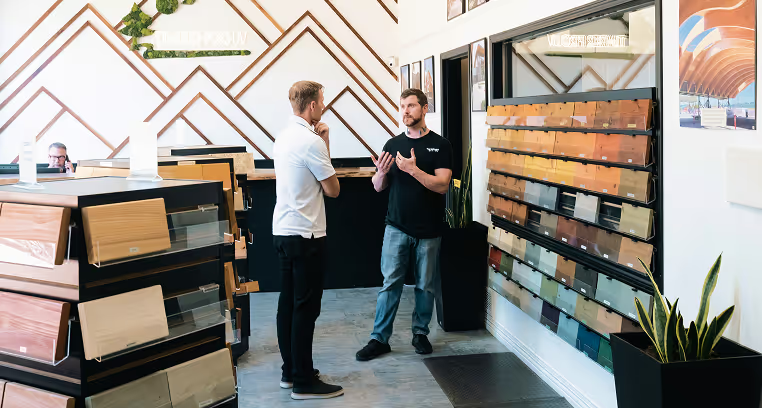
At Timber Pro Coatings, we offer consultations and support to help design teams develop custom coating solutions for mass timber projects with demanding air quality requirements. The work we did on Northlake Commons, and the lessons we learned there, inform how we approach every laboratory-compatible project.
If you are considering mass timber for a life sciences building, the conversation about coatings should happen early and should go deeper than VOC content on a label. The scientists who will eventually occupy that space are counting on it.
Get coating support for your next mass timber project
Fill out the form below to schedule a personalized consultation with our commercial team. We'll help you identify the right TimberPro solutions for your specific application.
Speak with a consultant
M-F 9AM - 5PM PST, Saturday & Sunday Closed
%20(1).jpg)

.svg)
%20(1).avif)
%201.svg)
%201.svg)
%201.svg)
%201.svg)
