.svg)
%201.svg)

%201.svg)

.svg)
.png)
A Friendly, Expert Deep Dive into Fire Testing Standards That Shape Our Industry.
If you’ve been around mass timber long enough, you know there are two types of conversations we all dread:
- The “Why is this so expensive?” conversation
- And the “Which fire test applies to our project?” conversation
The second one gets especially interesting when someone casually asks,
“Will this product pass ASTM E84 (in the USA) ?” (CAN/ULC-S102 if in Canada or EN13501 if in the UK.)
I know this is an important question, but if you don’t know the key technicalities, it can get awkward as it seriously questions your expertise.
Over the past 35 years working with architects, code officials, and manufacturers across North America and Europe, we’ve explained these fire tests hundreds of times, sometimes on job sites, sometimes in boardrooms, sometimes over coffee with a stressed project manager trying to decipher a code compliance matrix.
I believe mass timber is naturally predictable in terms of fire sensitivity. The confusing part isn’t the product, it’s the code landscape.
And today, I‘ve decided to put all the details in a simple way here, so that anyone can understand these standards, and you won’t have to ask experts about them.
So let’s begin.
TL;DR - Quick Takeaways
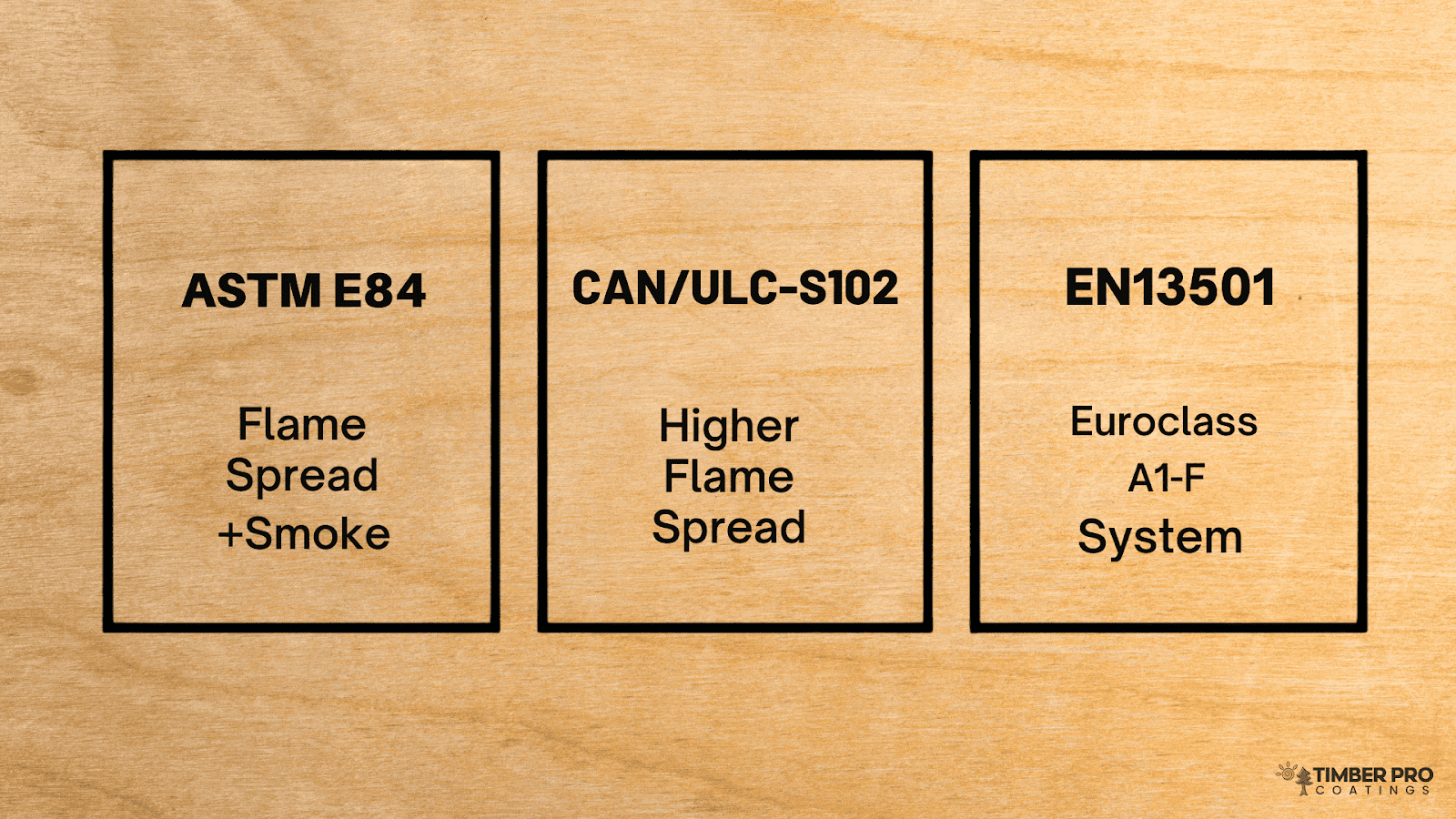
- ASTM E84 (US) measures flame spread and smoke development in a 25-ft tunnel commonly used to classify interior finishes including mass timber.
- CAN/ULC-S102 (Canada) is similar to E84 but uses different calculation methods, mounting conditions, and procedural details, which can produce slightly more conservative flame-spread values in some cases.
- EN13501-1 (Europe) classifies materials into A1–F using reaction-to-fire tests; more comprehensive than E84/S102.
- Mass timber performs strongly in reaction-to-fire evaluations that measure surface flame spread, fire behavior, and smoke production, and its results are heavily influenced by the choice of coatings and other surface treatments.
- Many untreated mass timber products test in the Class C range under E84/S102 and around Euroclass D‑s2,d0, though exact results depend on species, density, and product configuration. Higher ratings (Class A or Euroclass B/C) almost always require fire‑retardant treatments or coatings.
- Understanding these standards is essential for permitting, code compliance, and product specification, especially in cross-border projects.
Now let’s dive into the details.
Where and How Reaction-to-Fire Codes Apply
The market relies on standardized testing to quantify and ensure safety. That’s where these important classifications come in.
- ASTM E84 → U.S. interior finish classification
- CAN/ULC-S102 → Canadian surface burning classification for a range of interior finishes and building materials
- EN13501-1 → European reaction-to-fire classification for nearly all exposed products
Understanding these is foundational to smart mass timber design.
ASTM E84 – The U.S. "Tunnel Test" Explained
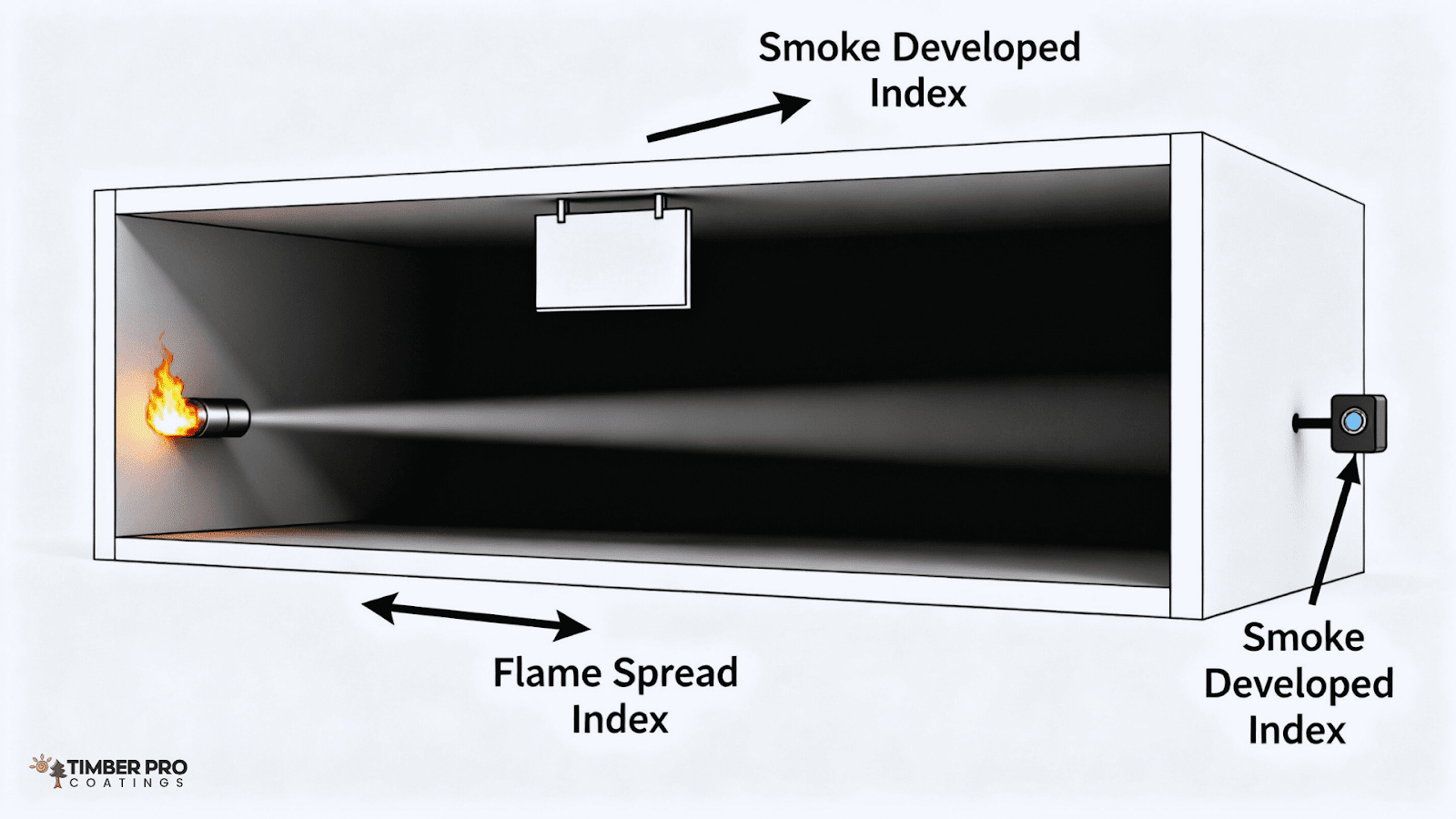
ASTM E84 often called the Steiner Tunnel Test is a 10-minute evaluation designed to quantify:
- Flame Spread Index (FSI)
- Smoke Developed Index (SDI)
It's a 25-foot Steiner Tunnel test, a bit like watching a miniature hallway fire under controlled conditions.
Classification Levels (US IBC / NFPA)
The International Building Code (IBC) uses ASTM E84 to assign Class A/B/C ratings:
Class A
- Flame Spread Index: 0–25
- Smoke Developed: 0–450
Class B
- Flame Spread Index: 26–75
- Smoke Developed: 0–450
Class C
- Flame Spread Index: 76–200
- Smoke Developed: 0–450
Mass timber products (like CLT and glulam) often test in Class B or C unless protected or coated.
With the right product coatings, Class A is achievable.
Key Insight (From 35 years in the field)
ASTM E84 is not a structural fire test. It doesn’t tell you how a beam or panel behaves under load.
It’s strictly about surface burning behavior; think “interior finishes,” not “fire resistance.”
So if you want exposed timber AND Class A, start planning coating strategies early.
Nobody likes the “we need $120k of extra coating work” surprise in Month 11.
CAN/ULC-S102 – Canada’s Stricter Twin of ASTM E84
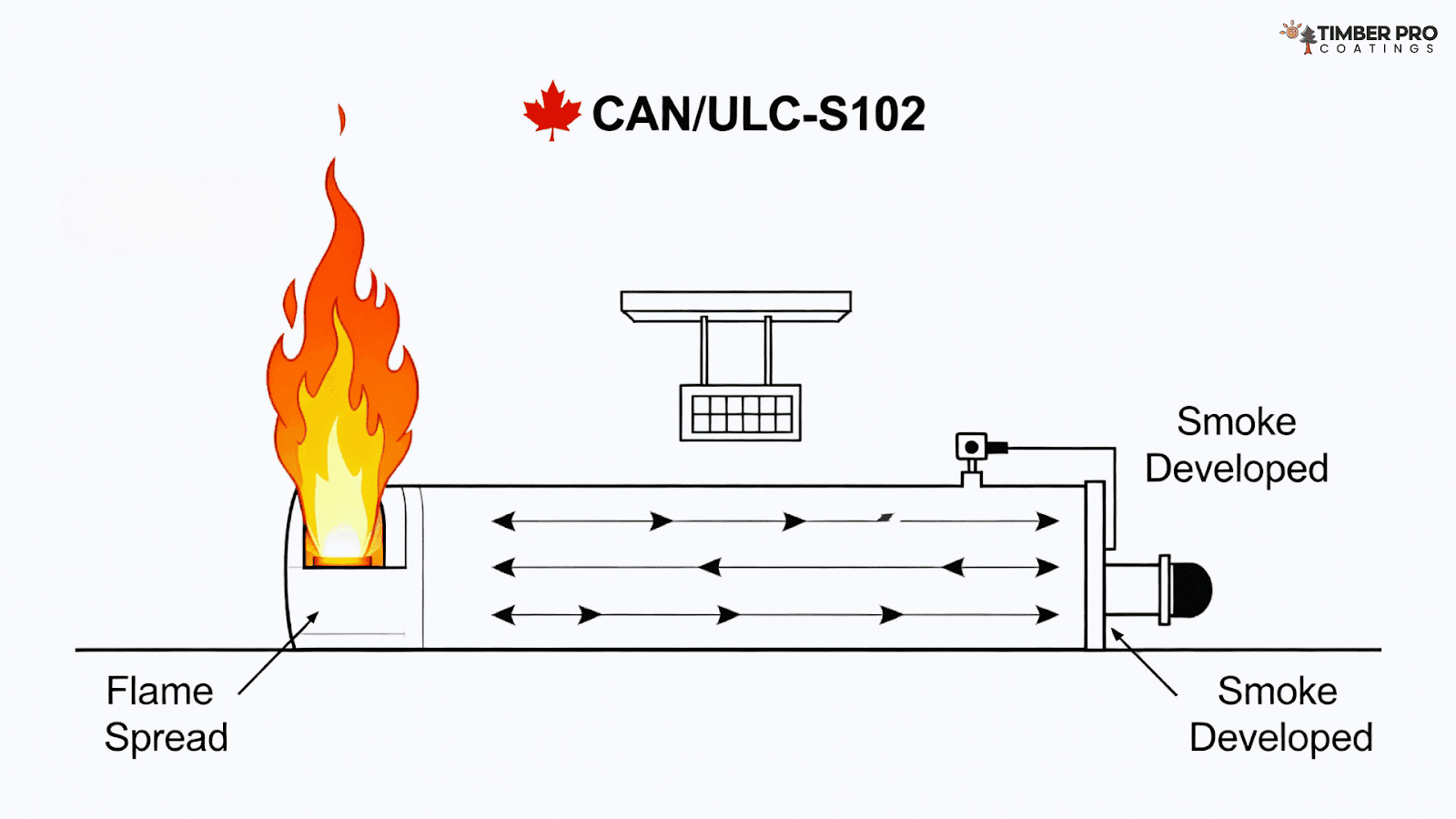
CAN/ULC-S102 is quite similar to ASTM E84, measuring similar metrics (flame spread + smoke), but with a slight difference in the calculations and procedures.
- Similar flame source
- Same Steiner Tunnel
- Different mounting, measurement
- Slightly different calculation rules
In practice, CAN/ULC-S102 can produce slightly more conservative flame-spread values in some cases because of different calculation rules, but overall results are generally similar with a little bit more strict requirements.
Canadian Classification (NBC)
Unlike E84, the National Building Code of Canada (NBC) does not use Class A/B/C terminology. It specifies numerical flame-spread limits.
- Flame-spread limit: < 25
- Commonly required for certain exit routes, corridors, stairwells, and other higher‑risk locations under specific NBC provisions.
- Commonly required for certain exit routes, corridors, stairwells, and other higher‑risk locations under specific NBC provisions.
- Flame-spread limit: < 50
- A typical maximum surface flame‑spread rating for many interior wall and ceiling finishes in frequently occupied areas, depending on the applicable NBC article and occupancy.
- A typical maximum surface flame‑spread rating for many interior wall and ceiling finishes in frequently occupied areas, depending on the applicable NBC article and occupancy.
- Flame-spread limit: < 75
- Sometimes permitted in selected occupancies or lower‑risk areas, where the Code allows a higher numerical flame‑spread rating.
- Sometimes permitted in selected occupancies or lower‑risk areas, where the Code allows a higher numerical flame‑spread rating.
NBC 9.10.17.1(1) sets a general maximum surface flame-spread rating of 150 for most interior walls and ceilings, while lower numerical limits such as 25, 50, or 75 apply only in specific locations and conditions referenced elsewhere in the Code.
Mass Timber Implications
Canadian AHJs (Authority Having Jurisdiction) will usually expect S102 results for proprietary or non-generic wood finish systems
If you’re building in Canada:
- For mass timber used as an exposed interior finish in Canada, authorities will almost always require a CAN/ULC-S102 test report for the specific products and configuration, especially CLT, glulam, NLT/DLT, or any timber element with coatings, sealants, or surface treatments.
- Consider fire-retardant coatings early in design if you’re targeting a better rating.
**Fire-retardant coatings can improve ratings, but only the exact tested and listed system (substrate, coating, surface preparation, etc.) is acceptable for compliance.
Why Is Canada Stricter?
Canada places strong emphasis on limiting vertical fire spread, especially in mid-rise and high-rise wood projects.
So if you're designing exposed interiors in Vancouver or Toronto, you’ll want to think about coatings early.
EN13501-1 – More Comprehensive System From Europe
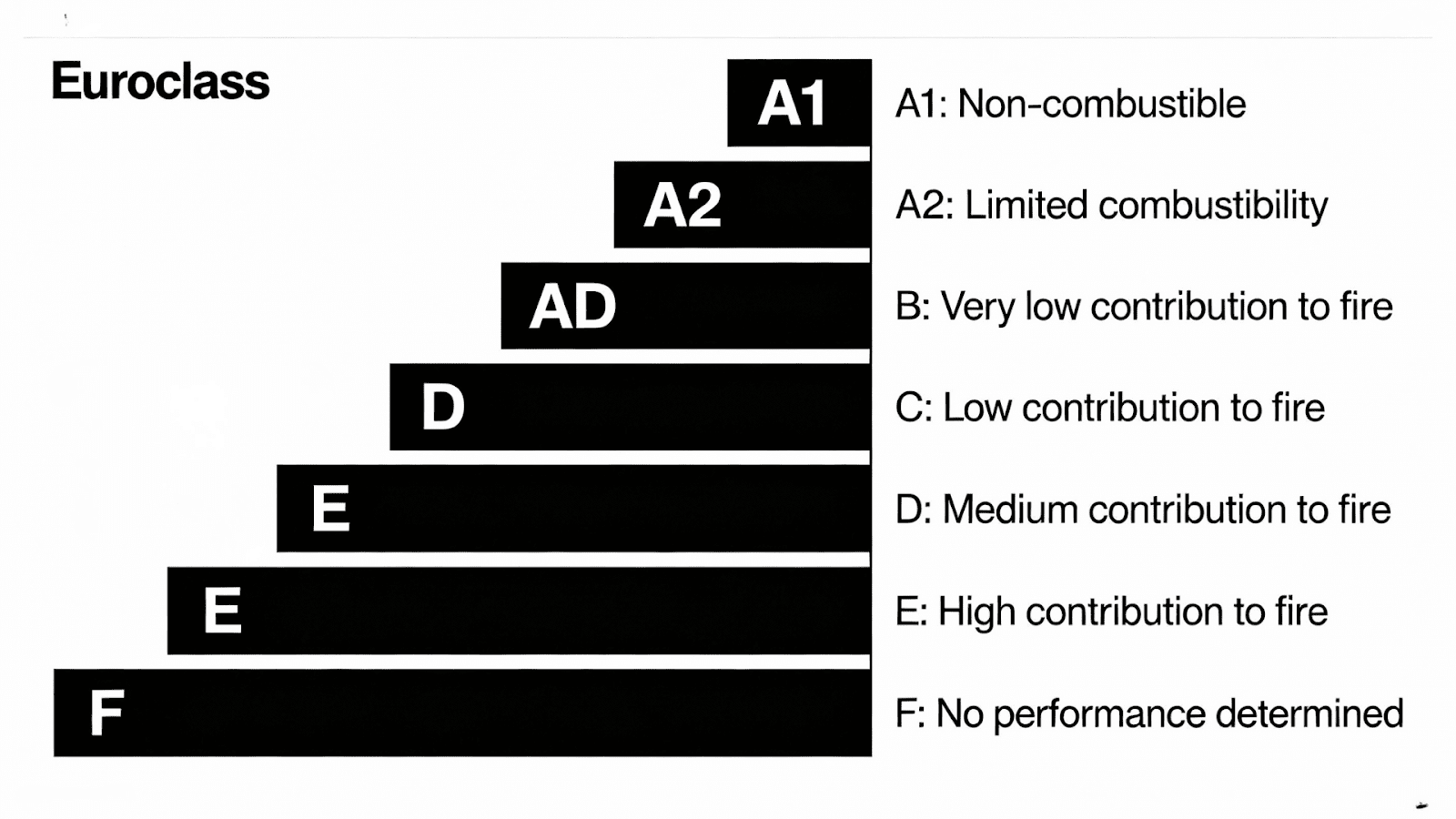
Europe approaches fire performance differently, more holistically.
EN13501-1 evaluates:
- Flame spread
- Heat release
- Smoke production
- Flaming droplets
- Overall contribution to fire growth
EN 13501-1 classifications come from the SBI test (EN 13823) and the small-flame test (EN 11925-2), not a tunnel test.
And the rating system here is also quite different.
Euroclass System
- Euroclass A1 / A2
- Description: Non-combustible
- Typical timber product placement: Usually not applicable for timber
- Description: Non-combustible
- Euroclass B / C
- Description: Very limited contribution to fire
- Typical timber product placement: Fire-retardant coated timber
- Description: Very limited contribution to fire
- Euroclass C / D
- Description: Limited/acceptable contribution
- Typical timber product placement: Uncoated timber (D-s2,d0)
- Description: Limited/acceptable contribution
- Euroclass E
- Description: Acceptable reaction
- Typical timber product placement: Rare for timber
- Description: Acceptable reaction
- Euroclass F
- Description: No Determination/Fail
- Typical timber product placement: Not representative of standard timber
- Many untreated solid wood and CLT products fall in the Euroclass D‑s2,d0 range, although the exact class depends on species, density, and product configuration. Achieving Euroclass C or B generally requires fire‑retardant modification or specialized coatings.
Why It’s More Comprehensive
Europe recognized early that fire performance isn't one-dimensional.
So EN13501 considers more factors that matter in real-world fires, especially in early fire growth phases.
Comparing ASTM E84 vs. CAN/ULC-S102 vs. EN13501
- Measures
- ASTM E84 (US): Flame spread + smoke
- CAN/ULC-S102 (Canada): Flame spread + smoke
- EN13501-1 (Europe): Reaction to fire (multi-metric)
- ASTM E84 (US): Flame spread + smoke
- Test Type
- ASTM E84 (US): Steiner tunnel
- CAN/ULC-S102 (Canada): Steiner tunnel
- EN13501-1 (Europe): SBI + small flame
- ASTM E84 (US): Steiner tunnel
- Strictness
- ASTM E84 (US): Moderate
- CAN/ULC-S102 (Canada): More conservative
- EN13501-1 (Europe): Most multi-paramter
- ASTM E84 (US): Moderate
- Typical Timber Outcome
- ASTM E84 (US): Class B/C
- CAN/ULC-S102 (Canada): Higher FSI than E84
- EN13501-1 (Europe): Euroclass C/D
- ASTM E84 (US): Class B/C
- Common Use
- ASTM E84 (US): Interior Finishes (IF)
- CAN/ULC-S102 (Canada): IF + Building Materials
- EN13501-1 (Europe): Most Building Materials
- ASTM E84 (US): Interior Finishes (IF)
Why mass timber performs differently across tests
- Wood behavior interacts uniquely with each test setup
- Adhesives, lamination, and surface treatments impact results
- Tunnel tests differ physically
- EU heat-release metrics measure differently than North American indices
Understanding these nuances helps avoid surprises when testing for compliance.
Key Takeaway
These tests aren’t interchangeable, even if marketing departments sometimes try to make them sound like they are. Only follow the ones that are built for your country.
Real-World Advice for Designers, Developers & Engineers
These are lessons we’ve learned over more than two decades of working with architects, engineers, code officials, and testing laboratories.
On job sites, in permitting meetings, and in front of more fire-test data than I can count.
1. Don’t rely on cross-border test reports.
Every region enforces its own fire-test standard for code compliance.
ASTM E84, CAN/ULC-S102, and EN 13501-1 are not interchangeable, and a result from one jurisdiction almost never satisfies another without a formal engineering assessment.
It’s a common source of project delays, and it’s entirely avoidable.
2. Coatings are your best friend, or your biggest headache.
A well-designed fire-retardant system can move a wood product from a Class C range into Class A under the right test standard.
But the reverse is also true: the wrong clear finish, applied at the wrong thickness, can degrade flame-spread performance enough to derail a compliance path.
If a project needs exposed timber and a high-performance rating, coatings must be part of the design conversation from day one.
#P.S. Fire-retardant coatings can significantly improve reaction-to-fire ratings, but building officials typically only accept systems that match the tested substrate, coating product, application thickness, and surface preparation shown in the report.
3. Always check sample prep in the test report.
Make sure to confirm how the sample was prepped.
Was the surface sanded? Coated? End-grain sealed?
Missing or mismatched details between the tested configuration and the installed product are one of the most common reasons fire‑test submittals get questioned or rejected during review.
And the base material matters!
A coating that achieved a Class A rating with plywood does NOT automatically make CLT with the same coating Class A.
Ratings apply to the tested combination only.
Meaning:
- Coating + plywood = one rating
- Coating + CLT = needs its own test
- Coating + glulam = needs its own test
Specifiers must use the exact report that matches the project substrate.
4. Check the “scope of test” before relying on any report
Not all tests cover:
- Thickness
- Layup/Orientation
- Adhesive type
- Surface texture/sanding level
- Coating system and build up
- Edge-sealing conditions
Any difference between the tested configuration and the installed product can invalidate the rating. Missing or mismatched details are one of the most common reasons for rejected fire-test submittals.
5. Coordinate with fire engineers early.
A qualified fire engineer can tell you when a new test is actually required and when a prescriptive or performance-based code path eliminates the need entirely. This avoids unnecessary testing, redesigns, and costly delays.
6. Reaction-to-fire does NOT mean fire resistance (structural performance).
These are not interchangeable.
Final Thoughts

Mass timber is one of the rare materials where the more you learn, the more you appreciate how ingeniously simple nature’s fire engineering truly is.
But that simplicity often gets tangled in a web of regional fire testing standards.
The good news?
Once you understand ASTM E84, CAN/ULC-S102, or EN13501, you hold one of the most important keys in mass timber design.
Whether you’re creating a fully exposed, biophilic office tower or a boutique CLT lodge, remember:
Fire testing isn’t just a checkbox. It’s a crucial design driver. The earlier you understand it, the more freedom you have to create beautiful timber spaces.
FAQs
1. Can mass timber achieve Class A (ASTM E84)?
Yes, with the right fire-retardant coating coating. Uncoated wood usually lands in Class B/C.
Fire-retardant coatings can improve ratings, but only the exact tested and listed system (substrate, coating, thickness, surface preparation) is acceptable for compliance.
2. Why is CAN/ULC-S102 more conservative than ASTM E84?
Canada uses the same tunnel design and ignition source but with slightly different measuring calculations, mounting conditions, and procedural details, which often produces more conservative (higher) flame spread values.
3. Are EN13501, CAN/ULC-S102 and ASTM E84 interchangeable?
No, they are not interchangeable.
4. Does finishing (staining, clear coat, etc.) affect flame spread ratings?
Absolutely. Surface finishes can alter ignition, heat release, and flame-spread behavior, and even small changes in film thickness or chemistry can shift the classification. Some clear coatings degrade performance rather than improve it.
Compliance requires using a finish system that has been tested on the same substrate, with the same conditions, as your project conditions.
5. Are exposed mass timber interiors allowed in mid-rise/high-rise buildings?
Increasingly yes. The IBC’s Type IV construction categories allow varying amounts of exposed mass timber, with specific limits on location and surface area.
Get coating support for your next mass timber project
Fill out the form below to schedule a personalized consultation with our commercial team. We'll help you identify the right TimberPro solutions for your specific application.
Speak with a consultant
M-F 9AM - 5PM PST, Saturday & Sunday Closed
%20(1).jpg)
%20(1).jpg)

.svg)
%20(1).avif)
%201.svg)
%201.svg)

%201.svg)
%201.svg)
